
Evaluation on PCC Household Support Fund 2021/22
The Village Hub was given £5000 mid December 2021 from Plymouth City Council to support vulnerable people through its activities in its premises on Devonport Road, Stoke. The money was stipulated to be redistributed entirely to people in need with a 5% allowance for administration costs.
Our excel sheet of data shows that we had 232 recorded visits since December 6th 2022. This data is collected from a tablet in the hub that visitors are encouraged to use as they leave to see what difference, if any, their visit has made. Some visitors are shy or suspicious of filling in data so we do not insist; and some visitors choose to take vegetables and any perishables off our honesty shelf outside rather than come into the hub, so there will be approximately 20% of visits that are not recorded.
We feel that respecting individual wishes regarding collecting data is paramount to their sense of autonomy, something that we feel is very important so that people are not just seen as beneficiaries because they are in need.
One comment is that we actually found it quite hard to spend the money, as the added value of providing surplus food compared to buying supermarket food is huge. In our excel reporting we have suggested that the value of each visit to our larder is approximately £20 as that is what it would have cost if we had taken that person shopping in the local Coop. However, in reality it has cost us less by using surplus food from supermarkets, substantial excess food that was available over the Christmas period, and Fareshare once they became active in the city in February. We only needed to do one large top up supermarket shop ourselves in the course of the time the grant was active for.
In addition to the recorded visits from December to March, we have been able to use our grant to ensure that we have a stocked larder for the remainder of 2022 through paying Fareshare for a weekly delivery up until next February. We have also worked with a local paypoint corner shop and put money on a prepaid debit card which will allow us to signpost people in need to the shop to be able to top up their gas and electric prepayment meters, mobile phone data, or buy essentials that we do not usually have in the Food Larder (particularly cleaning and hygiene products). It took us some time to get around to this system and we have only recently put it in place after researching prepaid cards for other hub purposes, however we hope it will prove a valuable way of assisting people in need, especially with energy. We noted that the Plymouth Energy Community part of the Household Support Fund finished early, February 14th 2022, and we were aware of many people coming in after this to talk about what could be done about their fuel crises. We referred these people to Citizens Advice but noticed a drop off as the support could not be given immediately as was the case with the PEC referrals which we made when the person was present.
We do see many people who take some time to pluck up the courage to admit to struggling with money and when they finally have that conversation with us it seems the best time to offer practical support is there and then.
We trialled several ways of spending the grant well to give the most support to people in need, based on our general framework of working with not for the people who live in Stoke and Morice Town. (This boundary is important to us for our sense of identity, so we referred people outside our area to other organisations more local to them who were also beneficiaries of the Household Support Fund).
We also working with DCFA to access £15 surplus food boxes that could be delivered by them directly to people’s doors.
We created a hot food voucher scheme so that we could pay for a hot meal for people who came through our doors in immediate serious need (some have not eaten for days, or have no access to cooking facilities). This worked well in part – local businesses who agreed to be part of the scheme were the Stoke Café, The Stoke Bar and Grill and the Stoke Kebab House. However the café had short opening hours, closing at 2pm, and the Stoke Bar and Grill felt “too posh” for some people, so most of the vouchers were for the kebab house. This meant that they didn’t have the social aspect we are after of someone being treated to a sit down meal, and volunteers sometimes had to cope with deciding whether someone was really in need or not to get one, making them judge and jury – something that did not fit our ethos of inclusivity. As word got out that we had these vouchers, we did have some people pop in saying, “Where is mine, so and so got one!” We feel that if we do the scheme again we will not use vouchers like this as it puts our volunteers in too difficult a position and creates a hierarchy between community members which is not helpful.
The great benefit of a food larder is that it is accessible to anyone, removes the stigma of accessing free food and allowing us to have conversations about individuals likes and dislikes, encouraging conversations around food.
One of our notable successes is that 2 recipients felt able to attend a course put on by Oncourse South West about how to cook good quality cheap meals using food from the larder, making it the first time they had entered City College, get accustomed to the environment and hopefully provide a bridge for them to get further involved in education in general.
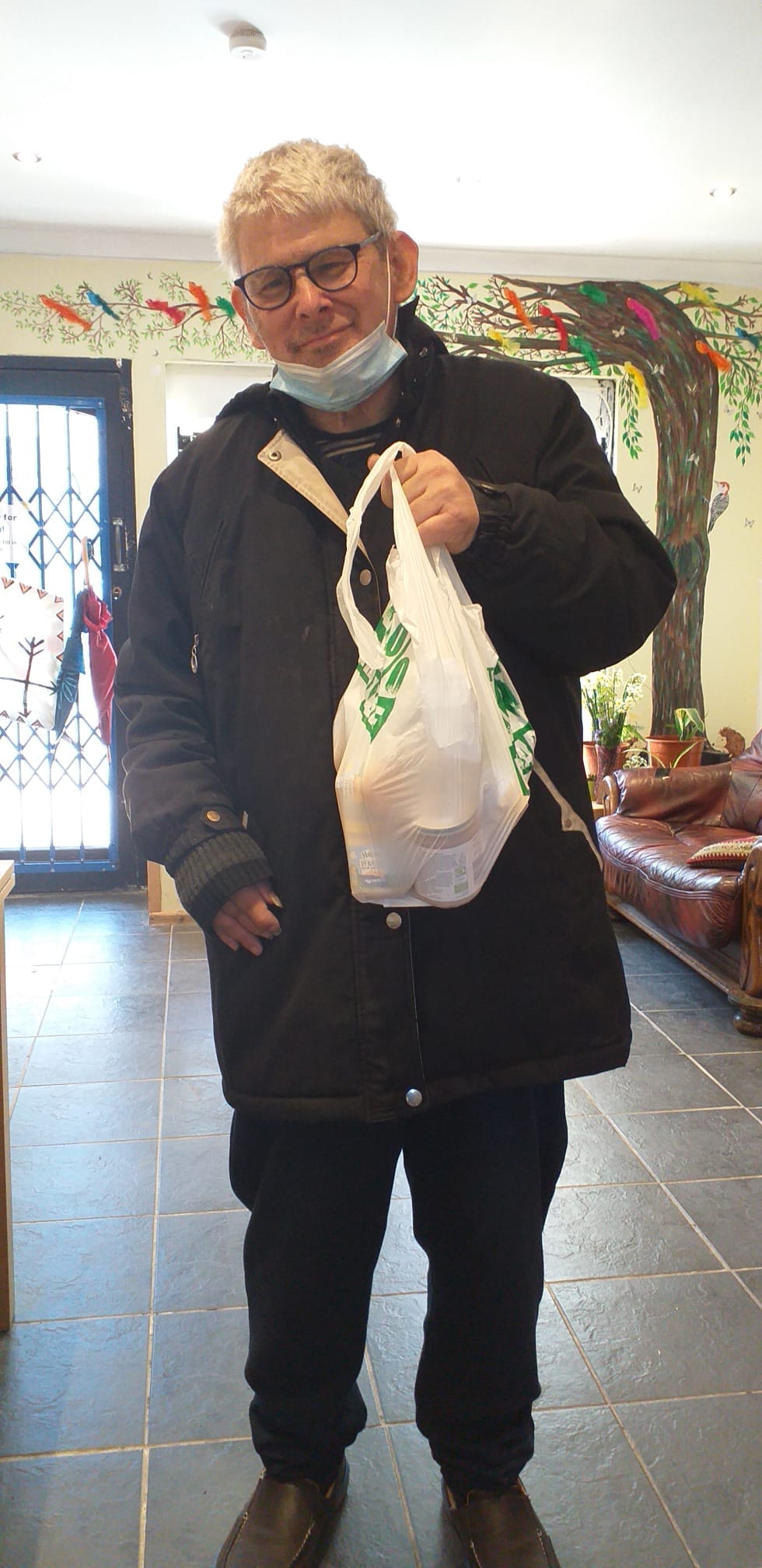
Another story is centred around Andrew (photo attached with his permission). Andrew lives with his step dad in supported accommodation since his mum died. Both are disabled, although Andrew is not quite deaf enough for a bus pass (he is 59, but his level of deafness is 72 in one ear, which passes the criteria, only 68 in the other which is 2 short of the criteria!). He also, we suspect, has differently abled learning patterns and sometimes struggles to wash or dress well. As a result of being a regular visitor he has accessed art workshops and social gatherings we have had. The photo shows him with a small bag of toiletries he bought for the Ukraine Appeal which we were collecting for. We were delighted that our support of his food budget enabled him to feel enabled to give to others in a worse condition than him. We see this empowerment of individuals enabling them to be part of the solution to their own and others problems as something to be celebrated.
Another story centres around a single mum who had lost custody of her children but through support from Trevi and others was building her life back up. She was having weekend contact with her children but not getting any additional benefits to feed them, or cope with the amount of energy and mobile data 2 teenage girls could get through in a weekend. We were able to help fill the gap and she now has one of her girls living with her full time and her benefits have kicked in to support this.
Another story centres around a gentleman who had lost his business and ability to work and had no means of supporting himself being 64 and suffering from poor mental health. He has been able to eat and look after himself much better, so much so that he now comes in and volunteers for us on a weekly basis.
We sometimes walk a wobbly line as several of our visitors have drug and alcohol dependencies. However, we have found that by feeding people and treating them with respect we have had only 1 incident of aggression caused by alcohol, and feel that we have helped temper behaviours and mood swings.
Our survey app data from our tablet reported that 22 people who gave this information felt less lonely, 23 felt more connected to their community, 63 felt brighter, 71 felt more cheered up and 10 ended up doing something creative (which meant we persuaded them to stay a bit longer in the hub and join an arts or gardening group for a while).
65 people arrived at the hub to access food support feeling either just ok or sad and 96 left feeling happy or very happy. (Again, not everyone fills in this request for information and we do not force them to).
One of the big issues we found with the HSF is that there was only £250 available for administrative purposes. We received a grant from the NLCF to help us fund some part time hours for freelancers, but we still depend on a mix of paid staff and volunteers to keep the Hub open. If we had financial support to fund some further afternoon, evening or weekend hours, we feel the level of support we could give would be much more.
We also would like training for our volunteers and part time staff as we are sometimes dealing with very complex needs and sometimes emergency situations which front line workers would be trained up for or would have support systems in place to be able to talk about their experiences. Whilst we do our best to provide a safe environment for everyone, we are not professionally trained. We would really appreciate the support and help of experts. We have put 3 part time workers through basic solution focussed practice training and have funding for a further one to do this course in April; and one of us did an invaluable morning’s learning on hoarding run by Livewell. However, it is quite difficult to fit training into hours as almost all our paid hours are spent working at the Hub or directly on Hub activities. Likewise, it is sometimes hard for volunteers to find extra time for training. We feel that factoring in some training costs or providing free training such as Appreciative Inquiry and other soft coaching/counselling techniques would be invaluable for future.
We hope this feedback is valuable. We have learnt a lot in delivering this money and feel we have a lot to say about how we could think more strategically in the future. We see ourselves as part of a bigger city wide system, so whilst we concentrate on people living in our area, we draw on the skills, experience and expertise of others on the city to enable us to grow and develop. We would like future funding to reflect this partnership working, rather than what seems like competitive bidding.
We believe that together we can find solutions and map ways of working that eventually can give the breathing space people need to solve their problems themselves and support others with their lived experience of how they have done this. This is crucial to the ethos of the Village Hub.