
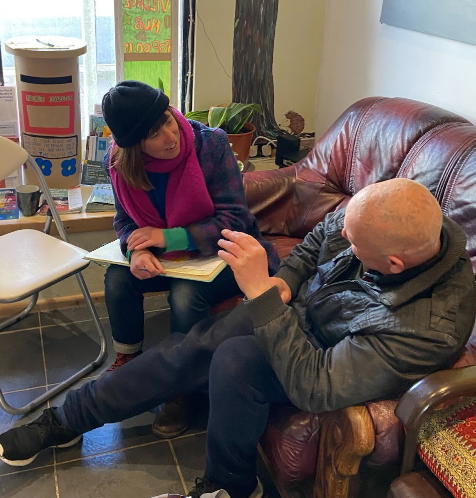
Food is vital. It’s pretty obvious we need it to survive and some people have much easier access to food than others, especially when you put us in our global setting that witnesses children still starving in the 21st Century.
These pictures of families in terrible stress shock us because they should not be happening in a world where so many of us regularly throw good food away. We all know this, but within our community we often hear the argument that charity should begin at home and we should be looking after our own.
We are all for a bit of community kindness and set up a community food larder during covid, not really thinking too much about why, just that it seemed a good thing to do.
Thinking more deeply about why though is the reason for writing this blog. Our underlying aim is to do things “with not for” our community. We never intended being the good folk who hand out food to the poor people – after all the entire point of a community larder is that anyone can wander in and grab something that takes their fancy regardless of their social, economic or health conditions.
Food is vital to life and we all need it – it’s one of those common denominators that makes us realise our similarities.
Yet in our western civilisation Food manages to speak more of differences. We are defined by what supermarkets we shop in, how often we eat out, where we eat out, how much we spend on food, and then how healthy, how fat and especially how much “in need” we are.
Poverty seems to mean that we need lots of food.
We have run our community larder since October 2020 and see around 20-50 people every week. We were given a local authority grant to help distribute aid over the winter, specifically around food, energy and water.
It is true that many people who come and visit us do so because they are in need. They know they will get at the very least a hot drink, someone reasonable to talk to and can help themselves to food from our larder shelves.
Since the grant we have busied ourselves making sure the larder shelves are full; but this has brought about its own set of problems and ethical questions. We had previously relied on a supply of redistributed food, fitting into our ethos that we throw too much away already. For various reasons (some just temporary and due to timing), the redistributed supply chain in our city was experiencing hiccups, so we needed to shop. This brought us into the field of who should we shop for – only those “in need” as anyone else should buy their own food? So how do we decide who is in need or not?
Stock piling became an issue. Were we enabling addictions to bulging cupboards, hoarding or just over eating by our supply of free food?
We also created vouchers for people to get a local hot meal – presuming that some people who come and see us have no access to cooking – but we discovered many other reasons for needing a hot meal – not liking what was in the larder, not having the inclination or skill to cook food, just wanting to have a treat or take the kids out, and most uncomfortably fairness – “You gave a voucher to them, why can’t I have one?”
We felt we had slipped into exactly the opposite of doing things “with not for” our neighbours, and had inadvertently become those in control.
“Please Sir, can I have some more?”
To try and wrestle ourselves away from images of workhouses and orphanages (after all, surely we are far removed from Victorian methods of “helping the poor”) we have tried involving our visitors in how we manage the grant.
Tom for example has helped us write out a list of questions to ask people before they get given a voucher and a points system which is “fair”. Tom has spent his entire life thinking he has to blag for what he gets, learning to work the system to his advantage. He is a really clever man, but not perhaps the “heartstring tugging story” the system has asked us to supply to show how generous they have been.
Instead we would like to put forward Tom’s story as a testimony to ingenuity and entrepreneurship which, if he was in a different story, would make him likely to melt the heart of Alan Sugar and win the Apprentice hands down.
And then there is Luke, on the verge of being evicted, refusing to go back to hostel living which he sees as a step backwards. He doesn’t trust a soul and a life of relying on his wits to survive has made him exhausted and paranoid. Lying is just a way of keeping himself alive. He’ll often decide he’s not going to eat just to express his anger.
And of course Andy. Andy comes in from the pub as he knows he can spend more there because he can pick up some bits from our larder on his way home. He has had numerous violent fights with his neighbours so needs the alcohol for dutch courage and the food for bartering.
So many people we see feel part of a system that seems to be happy keeping them as the “have nots” so there can still be the privileged group of “haves”.
In trying to tell a more truthful narrative, we’d like to introduce Andrew
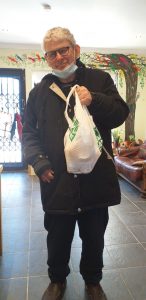
Andrew lives with his step dad in supported accommodation since his mum died. Both are disabled, although Andrew is not quite deaf enough for a bus pass (he is 59, but his level of deafness is 72 in one ear, which passes the criteria, only 68 in the other which is 2 short of the criteria!). He also, we suspect, has differently abled learning patterns and sometimes struggles to wash or dress well. As a result of being a regular visitor he has accessed art workshops and social gatherings we have had. The photo shows him with a small bag of toiletries he bought for the Ukraine Appeal which we were collecting for. We were delighted that our support of his food budget enabled him to feel enabled to give to others in a worse condition than him. We see this empowerment of individuals enabling them to be part of the solution to their own and others problems as something to be celebrated.
Trevor had lost his business and ability to work and had no means of supporting himself being 64 and suffering from poor health. He has been able to eat and look after himself much better, so much so that he now comes in and volunteers for us on a weekly basis.
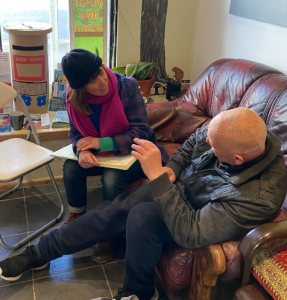
We sometimes walk a wobbly line as several of our visitors have drug and alcohol dependencies. However, we have found that by feeding people and treating them with respect we have had only 1 incident of aggression caused by alcohol, and feel that we have helped temper behaviours and mood swings.
Our survey app data from our tablet reported that 22 people who gave this information felt less lonely, 23 felt more connected to their community, 63 felt brighter, 71 felt more cheered up and 10 ended up doing something creative (which meant we persuaded them to stay a bit longer in the hub and join an arts or gardening group for a while).
65 people arrived at the hub to access food support feeling either just ok or sad and 96 left feeling happy or very happy. (Again, not everyone fills in this request for information and we do not force them to).
And the lovely Andy and his mate Pete have just spent a day clearing our back lane of some especially gruesome flytipping along with other volunteers.
We are not saying there isn’t need and poverty. We just believe that the current system is not working to address the real issues. Media headlines that scream about how we are falling below the breadline profoundly fail to ask why should human beings have to be supported to have basic rights – food, shelter, safety.
Could we not have a different society, where all our community members have equal access to healthy nutritious food, decent warm homes and freedom from intimidation and violence. We’d like to see these things as a right, not something you have to fight for. Right now, even those who have got these necessities seem to believe they only got them by fighting, striving and surviving – no difference in how many of our visitors see the world.
We aren’t expecting to find the solutions, but we would much rather not be part of the problem. As much of our work lies in building relationships in our community, we are striving to have conversations as equals, giving dignity and choices, not just a can of beans.
Perhaps a more cooperative system that we all pay a bit into could bring about a better distribution of food? After all this is how the National Health Service started.
Is there a way of creating the seeds of a National Food Service in our little community?